How to Select the Right Anchor Bolt for Concrete Applications
How to Select the Right Anchor Bolt for Concrete Applications
Selecting the right anchor bolt for concrete is a structural decision — the wrong choice can lead to fastener pull-out, concrete cracking, or catastrophic joint failure. With wedge anchors, sleeve anchors, shield anchors, drop-in anchors, and chemical anchors all solving different problems, understanding how each works and when to use it is essential for safe, reliable construction.
1. How Concrete Anchors Work
Concrete anchors generate holding force through one of three mechanisms: mechanical expansion (the anchor expands against the concrete hole wall as load is applied), friction (the anchor grips the hole surface through compressive force), or chemical bond (adhesive fills and bonds to both anchor and concrete). Understanding which mechanism your anchor uses helps predict how it will perform under different load directions — important because pull-out load (axial tension) and shear load (perpendicular to the anchor axis) have different characteristics for each anchor type. ScrewBazar supplies concrete anchors across all working mechanisms.
2. Wedge Anchors — Heavy-Duty Mechanical Expansion
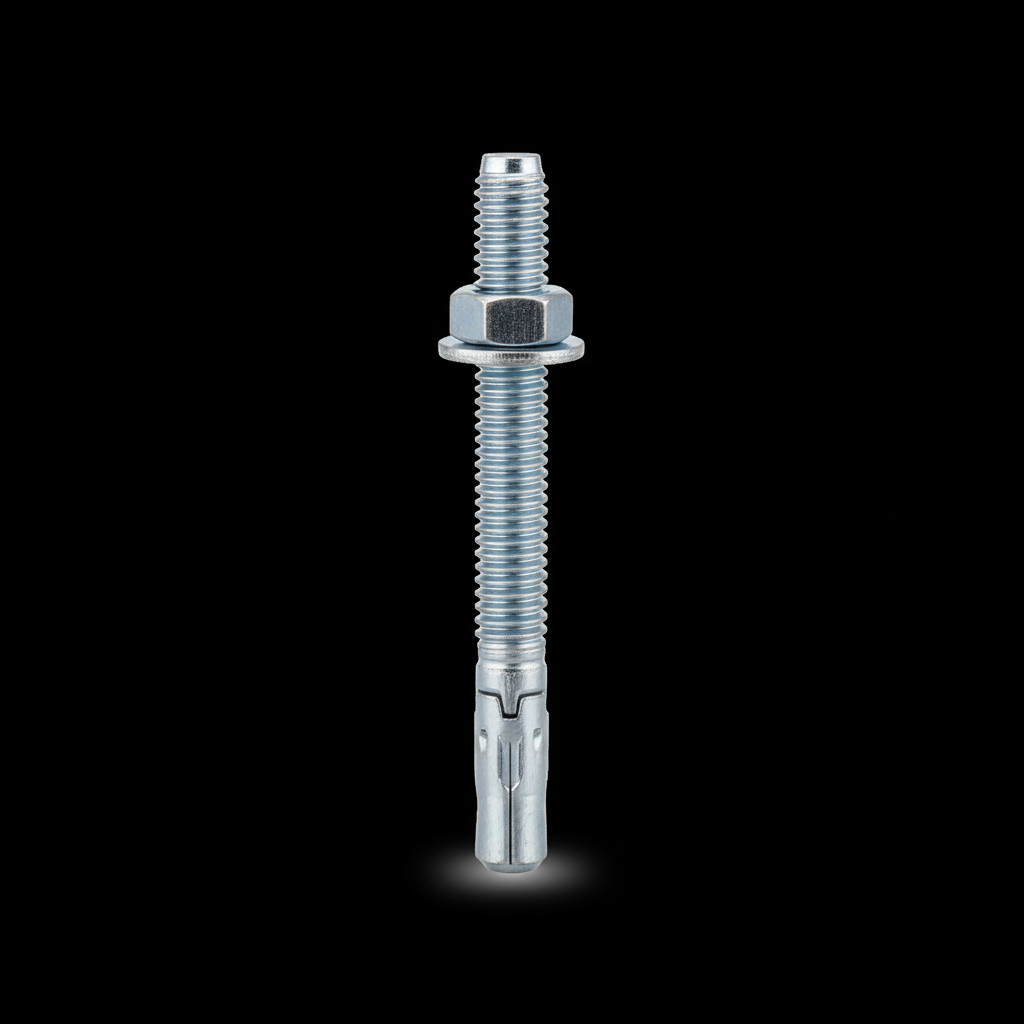
Wedge anchors are the most commonly used heavy-duty concrete anchor bolt. They consist of a threaded rod with a wedge clip at the bottom. When the nut is tightened, the threaded rod pulls up, forcing the wedge clip to expand against the concrete hole wall. Wedge anchors are suitable for solid concrete only (not hollow block or brick) and provide high load capacity — typical M10 wedge anchor achieves 8-12 kN pull-out in C20 concrete. They are permanent (cannot be removed without breaking) and are the standard choice for structural steel base plates, machinery anchor bolts, post-installed anchor bolts in columns and slabs, and equipment pads. Available in zinc-plated steel and stainless steel SS304 at ScrewBazar.
3. Sleeve Anchors — Versatile Medium-Duty Option
Sleeve anchors have an expansion sleeve that surrounds the bolt body. As the bolt is tightened, the sleeve expands uniformly around its circumference, providing a larger contact area with the concrete than a wedge anchor. Sleeve anchors are more tolerant of cracked concrete and near-edge installation than wedge anchors, and can be used in concrete, brick, and hollow block (with reduced load ratings). They are the preferred choice for medium-duty applications: handrail posts, facade brackets, HVAC equipment supports, sign posts, and pipe clamps. Available in M6 to M16 sizes, zinc-plated and stainless steel SS304.
Shop Concrete Anchors →
Shop Concrete Anchors →
4. Drop-In Anchors — Flush-Mount Internal Thread
Drop-in anchors are internally-threaded female anchors set flush with or below the concrete surface. A setting tool is used to expand the anchor into the hole, after which a bolt or threaded rod is screwed directly into the anchor. Drop-in anchors are ideal where a flush or recessed fixing point is required (overhead concrete, soffits, pre-installed fixing points in slabs for suspended equipment). The anchor is set before the load structure is positioned — useful in pre-cast concrete work and when the fixing point must be set ahead of installation. Common sizes M8 to M20 for overhead applications in commercial construction.
5. Shield Anchors — Light to Medium Load Range
Shield anchors (also called rawl anchors or plug anchors) consist of a lead or zinc alloy expansion shell that is tapped into a drilled hole, accepting a standard machine screw or bolt. As the screw is driven in, the shield expands against the hole wall. Shield anchors are suitable for light-to-medium loads in concrete, brick, and masonry — fixing electrical conduit, light fittings, plumbing clips, timber battens, and door frames. They are not suitable for structural or overhead applications where high pull-out loads are required. Very easy to install with no specialist tooling — the shield is pushed in with a hammer, then the screw is driven with a standard driver.
6. Chemical Anchors — Maximum Load Capacity
Chemical anchors (resin anchors) use a two-component epoxy or polyester resin injected into a cleaned hole to bond the anchor rod to the concrete. The chemical bond fills all voids and irregularities in the hole, creating extremely high pull-out and shear resistance — often double or triple that of equivalent mechanical anchors. Chemical anchors are essential for: high-load structural connections (mezzanine columns, overhead lifting beams, structural steel anchored to existing slabs), cracked concrete where mechanical anchors cannot be used, close-to-edge installations where mechanical anchors would cause spalling, and rebar continuity connections. The resin requires full cure time (typically 1-24 hours depending on temperature) before loading.
7. Selection Checklist
When selecting an anchor bolt for concrete, work through this checklist: (1) Concrete type — solid, hollow block, or brick? (wedge and drop-in for solid only), (2) Load magnitude — what pull-out and shear loads must the anchor carry? (size and type accordingly), (3) Edge and spacing distances — too close to an edge reduces capacity; check supplier tables, (4) Cracked or uncracked concrete? (cracked concrete requires special anchor ratings), (5) Removable or permanent? (wedge anchors are generally permanent; sleeve and shield anchors can be removed), (6) Environment — outdoor, coastal, chemical? (specify SS304 or SS316 accordingly). ScrewBazar can provide load capacity tables and installation guidance for all anchor bolt types we supply.
Concrete Anchors Supplied Across India
ScrewBazar supplies wedge anchors, sleeve anchors, shield anchors, and drop-in anchors in zinc-plated and stainless steel across all common sizes. For structural applications requiring load calculations, contact our technical team for guidance on anchor bolt selection, edge distances, and appropriate grades for your concrete specification.