Cheese Head Screws — When and Why to Use Them
Cheese Head Screws — When and Why to Use Them
Cheese head screws are one of the less commonly encountered machine screw head types — but in the applications where they excel, they outperform every alternative. Their distinctive thick, narrow cylindrical head provides a deep socket for the drive tool and a robust bearing surface, making them the preferred choice in precision instruments, electrical equipment, and applications where access is restricted.
1. What Is a Cheese Head Screw?
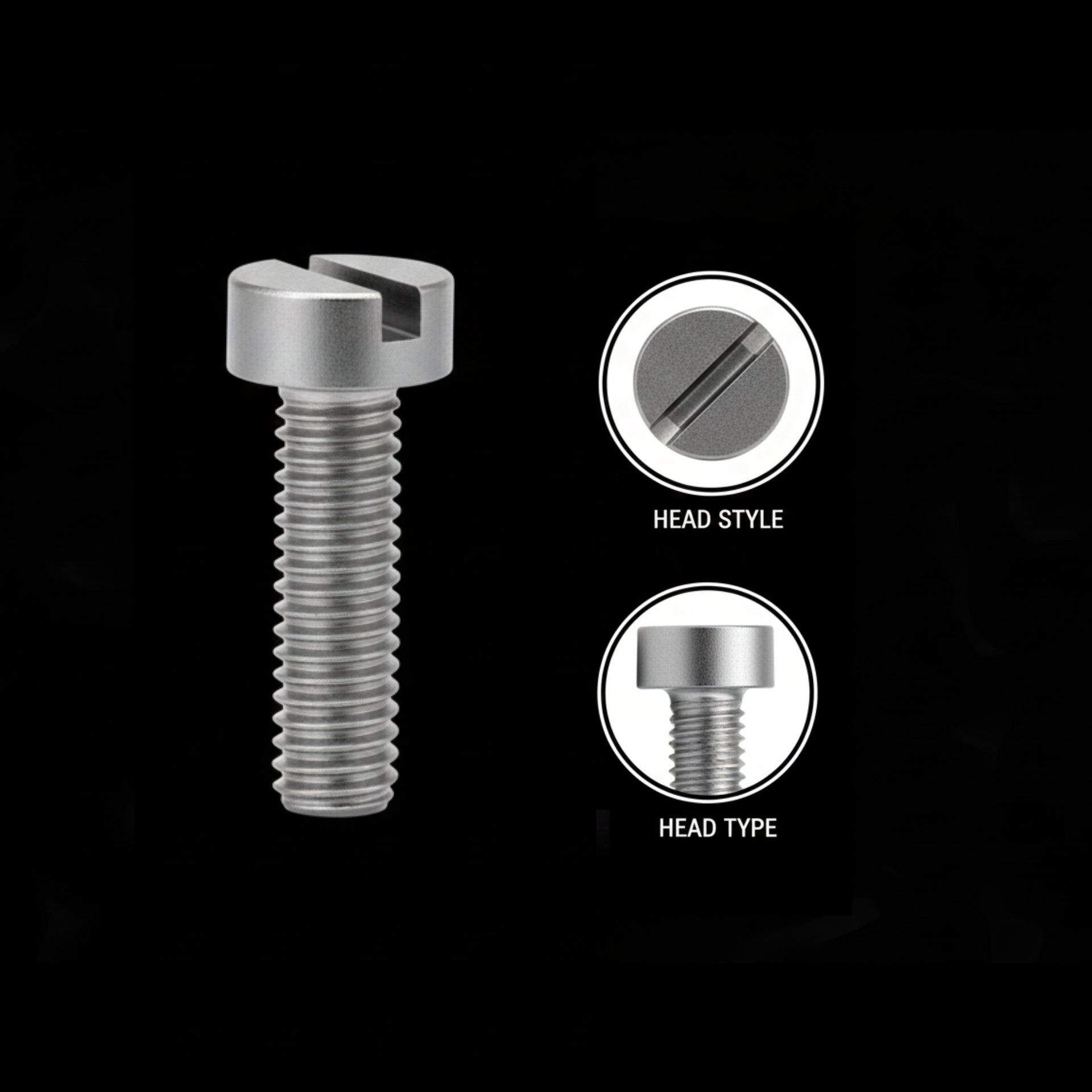
Cheese head screws have a cylindrical head with a flat top, flat bottom, and a height-to-diameter ratio that is larger than a pan head but smaller than a socket head cap screw. The name comes from the head resemblance to a wheel of cheese. The flat sides of the cylindrical head allow the drive slot (or cross-recess) to be cut deep into the head, providing excellent tool engagement. Cheese head screws are typically available in slotted or Phillips drive in metric sizes from M1.6 to M10. At ScrewBazar, cheese head screws are stocked in stainless steel SS304 and zinc-plated mild steel for the most common metric sizes.
2. Cheese Head vs Pan Head: The Key Differences
The main practical difference between cheese head and pan head screws is the head height and drive depth. A cheese head has a taller, narrower head than a pan head — and because the slot or cross-recess is cut into a taller head, the drive engagement is deeper and more positive. This deeper drive makes cheese head screws more resistant to driver cam-out and tool slippage, which matters in precision assembly where screw heads must not be damaged. In terms of appearance, the cheese head has a more industrial, mechanical look — visible in control panel assemblies, relay contacts, and electrical terminal blocks.
3. Typical Applications
Cheese head screws are standard in electrical and electronics applications where screws are repeatedly adjusted: terminal block and relay clamping screws, electrical panel mounting screws, precision instrument housings, laboratory and test equipment assemblies, switchgear and control cabinet construction, and mechanical components requiring frequent adjustment access. In these contexts the deep drive slot is essential — a flat-bladed screwdriver must engage positively to tighten and release terminal connections without slipping and damaging adjacent components. The narrow cylindrical head also fits in grooves and recesses that a wider pan head could not enter.
4. Slotted vs Phillips Drive for Cheese Heads
Most cheese head screws are slotted, and this is not by accident. For terminal block and electrical adjustment screws, slotted drives are preferred because: they work with simple flat-bladed screwdrivers without special tooling, the engagement is easily inspected to confirm the driver is fully seated, and the drive geometry suits hand-adjustment where torque control by feel is more reliable than with Phillips (which can cam out unpredictably). Phillips cheese head screws exist and are used in general precision assembly where power tools are used and cam-out helps prevent over-tightening in sensitive components.
5. Materials and Finishes
Cheese head screws are available in stainless steel SS304 (preferred for food, pharmaceutical, and outdoor electrical enclosures), zinc-plated mild steel (standard for indoor electrical and mechanical assembly), and brass (non-sparking, non-magnetic, and corrosion-resistant for specialist electrical and marine applications). For most cheese head screw applications in control panels and electrical equipment, zinc-plated mild steel is the standard specification — sufficient corrosion resistance for indoor enclosures and a cost-effective choice at the volumes that electrical assembly demands. ScrewBazar stocks brass and stainless cheese head screws for applications requiring those specific properties.
Browse Machine Screws →
Browse Machine Screws →
6. Sizing Cheese Head Screws
Cheese head screws follow standard metric sizing. The most common sizes in electrical and control applications are M3, M4, and M5 — corresponding to the terminal block and connector sizes used across Indian industrial equipment. Thread pitch is standard metric coarse: M3x0.5, M4x0.7, M5x0.8. Length is measured from under the head to the tip (standard for non-countersunk heads). Ensure adequate thread engagement in the tapped hole — minimum 1.5x the nominal diameter for steel, 2.5x for aluminium and softer materials. For M3 cheese head screws in steel control panels, a 6mm or 8mm length is typically sufficient.
7. When Cheese Head Is the Right Choice
Specify cheese head screws when: the application is electrical or electronic assembly requiring deep drive engagement for reliable torque control, the head must fit in a constrained space that excludes a wider pan head, repeated adjustment access is required (terminal connections, relay settings), or you need a screw whose head profile looks correct in a control panel or instrument context. For purely structural fastening or aesthetic visible fastening, SHCS, button head, or pan head screws are usually better choices. Cheese head screws are a specialist fastener — not the most common, but essential in the applications where they fit.
Cheese Head Screws in Stock
ScrewBazar stocks cheese head screws in slotted and Phillips drive, stainless steel SS304 and zinc-plated, from M2 to M8. Contact our team for availability, bulk pricing, and same-day dispatch on stock sizes.