Complete Guide to Nuts: Hex, Nyloc, Wing, Lock & More
Complete Guide to Nuts: Types, Materials, Threading, and Selection
Nuts are the second half of every bolted joint, and the wrong choice creates assemblies that work loose, corrode, strip threads, or fail under load. The range of nut types available is wider than most buyers realise — from standard hex nuts to self-locking nyloc nuts, vibration-resistant castle nuts, and specialised insert nuts for sheet metal. Understanding the options, the materials, the threading systems, and when to use which type is the foundation of reliable fastener specification. This guide covers all major nut categories with technical data on torque, materials, and thread standards.
1. The Major Nut Types and What They Do
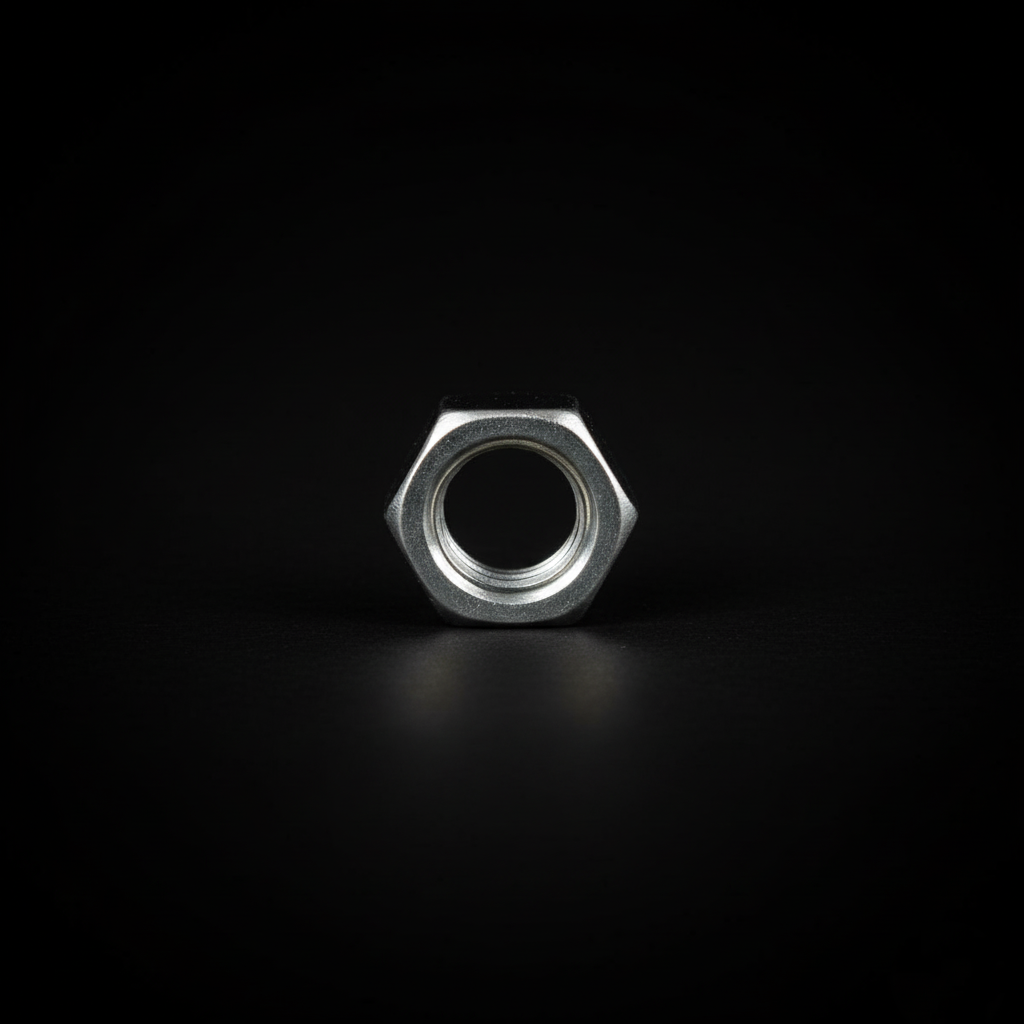
Hex nuts are the standard for the vast majority of bolted joints — six sides, through-threaded, tightened with a spanner or socket. Available in standard height and thin (jam) nut variants; jam nuts are used stacked against a standard hex nut to create mechanical interference that resists loosening. Square nuts provide four sides instead of six, used in T-slot profiles (machine tables, aluminium extrusions) where the square body prevents rotation in the channel. Flange nuts include an integrated serrated or plain flange beneath the hex head, distributing load over a larger area and providing anti-loosening action as the serrations bite into the mating surface. Coupling nuts (long nuts, extension nuts) are elongated hex nuts used to join two threaded rods end-to-end or extend the effective length of a bolt — common in construction suspended ceilings, sign mounting, and structural framing. Castle nuts (castellated nuts) feature slots across the top face into which a cotter pin is inserted after the bolt hole aligns, physically preventing rotation in safety-critical joints such as steering components, wheel hubs, and aircraft control linkages. Wing nuts have two projecting wings for hand-tightening without tools, used wherever frequent adjustment or removal is required — jig clamping, test fixtures, access panels, and equipment requiring regular field servicing. Dome nuts (cap nuts) close over the exposed thread end, protecting it from damage and providing a finished appearance for visible fastening — furniture, architectural metalwork, and sanitary fittings.
Shop All Nut Types →
Shop All Nut Types →
2. Locking Nuts: Nyloc, Flange Nyloc, and All-Metal Lock Nuts
Standard hex nuts can loosen under vibration — this is the fundamental limitation of any unrestrained threaded connection. Locking nuts solve this through three mechanisms: nylon insert, serrated flange, or deformed thread. Nyloc nuts contain a nylon insert ring at the top of the nut. As the bolt engages, it forces into the nylon, which grips the thread and creates prevailing torque — resistance to rotation in either direction, not just tightening. This maintains clamp load under continuous vibration without deforming the fastener. Nyloc nuts are technically single-use by strict engineering standards (the nylon deforms permanently on first installation), though in practice they are reused in low-stakes applications. Operating temperature is limited to approximately 120°C — above this the nylon softens and loses grip. Flange nyloc nuts combine the nylon insert with a serrated flange, adding a second locking mechanism. The serrations bite into the mating surface as the nut is tightened, resisting rotation even if the nylon insert wears over time. These are popular in automotive assembly — suspension components, exhaust hangers, and engine bay brackets. All-metal prevailing torque lock nuts use a distorted thread profile rather than nylon, providing reliable locking from -40°C to +200°C or higher. They are specified for exhaust systems, engine components, and industrial furnaces where nylon inserts would fail. Maximum reuse cycles are typically 5–10 before the prevailing torque falls below specification.
Browse Lock Nuts →
Browse Lock Nuts →
3. Material Grades: SS304, SS316, Brass, Nylon, and High-Tensile Steel
Material selection for nuts is driven primarily by the operating environment — corrosion, temperature, chemical exposure, and electrical requirements — rather than purely by strength. Mild steel zinc-plated nuts are the standard for indoor mechanical assemblies, machinery, furniture, and general fabrication where corrosion is not a concern. The zinc coating provides basic humidity protection, not salt spray or chemical resistance. Stainless steel SS304 (18% chromium, 8% nickel) resists atmospheric corrosion, fresh water, food acids, and moderate chemicals. Suitable for outdoor equipment, food processing machinery, pharmaceutical equipment, and marine environments with limited salt exposure. Tensile strength is approximately 600–700 MPa. SS316 adds 2–3% molybdenum to the SS304 composition, providing significantly improved resistance to chlorides, seawater, bleach, and dilute acids. Specified for coastal construction, swimming pool fittings, chemical plant equipment, and marine hardware where SS304 would pit and stain. Brass nuts (CZ108 alloy, 63% copper / 37% zinc) are specified for electrical applications requiring conductivity, decorative visible fastening, and marine fittings where galling against stainless bolts must be avoided. Nylon nuts create fully non-metallic assemblies — essential for electronics work where any metallic nut could create a ground path, and for food and pharma applications requiring non-metallic contact zones. PA66 grade, operating temperature to 120°C. High-tensile steel nuts (Grade 8, Grade 10 per ISO standards) are specified for structural and mechanical joints where the bolt is loaded near its yield point. Standard hex nuts must never be paired with high-tensile bolts (8.8, 10.9, 12.9) without confirming the nut grade matches — an under-rated nut will strip threads before the bolt reaches its design load.
4. Threading Standards: Metric, UNC, and UNF
Most fasteners sold in India use the ISO metric thread system, designated by M followed by the nominal diameter in millimetres: M3, M4, M5, M6, M8, M10, M12, M16, M20, M24. Each metric size has a standard coarse thread pitch and a fine thread pitch. For nuts, the standard (coarse) pitch is used unless specifically stated otherwise. Standard coarse pitch values: M4 = 0.7 mm, M5 = 0.8 mm, M6 = 1.0 mm, M8 = 1.25 mm, M10 = 1.5 mm, M12 = 1.75 mm, M16 = 2.0 mm, M20 = 2.5 mm. Fine threads are used in precision assemblies, thin-walled components, and applications requiring finer clamping adjustment. UNC (Unified National Coarse) and UNF (Unified National Fine) threads follow the imperial inch system, used in older machinery, American-designed equipment, aerospace hardware, and imported products. UNC and metric threads are not interchangeable — forcing a metric bolt into a UNC nut will cross-thread and destroy both fasteners. UNC threads are identified by diameter in inches and threads per inch: for example, 1/4-20 UNC means 1/4 inch diameter with 20 threads per inch. A thread pitch gauge is the reliable way to confirm thread type when specification documentation is unavailable. When sourcing replacement nuts for imported equipment, always measure the thread pitch and confirm the system before ordering.
5. Torque Specifications for Common Nut Sizes
Tightening torque determines the clamp load in a bolted joint. Under-tightening leaves the joint slack and vulnerable to loosening; over-tightening stretches or strips the fastener. Recommended installation torques for standard hex nuts paired with zinc-plated carbon steel bolts (lubricated threads, achieving approximately 75% proof load): M4 — 3.0 Nm. M5 — 5.5 Nm. M6 — 9.5 Nm. M8 — 23 Nm. M10 — 45 Nm. M12 — 78 Nm. M16 — 195 Nm. M20 — 380 Nm. For stainless steel nuts and bolts, reduce torque values by approximately 10–15% compared to carbon steel figures — stainless steel has lower yield strength and is prone to galling (thread seizure caused by friction welding) if overtightened. Apply anti-seize compound (copper-based or nickel-based) to stainless threads before assembly to prevent galling. For nyloc nuts, add approximately 15–25% to the above figures to account for prevailing torque from the nylon insert. Always verify torque values against the fastener manufacturer's published data for safety-critical structural applications — the figures above are guidelines for general assembly, not engineered structural calculations.
6. Nyloc Nuts vs Plain Hex Nuts: The Practical Decision
The choice between a nyloc nut and a plain hex nut comes down to one question: will the joint be subjected to vibration, repeated loading, or temperature cycling that could work the nut loose over time? Plain hex nuts are appropriate for static joints — assemblies tightened once and remaining at rest under constant load. Structural steelwork, machinery frames, furniture, and pipe flanges loaded by constant static pressure are examples where plain hex nuts are the correct choice. Nyloc nuts are appropriate for dynamic joints — assemblies subject to vibration, oscillation, or repeated loading cycles. Automotive suspensions, engine mounts, fan and motor housings, conveyor frames, and any assembly close to a vibration source should default to nyloc nuts unless an alternative locking method (thread locker compound, tab washer, castle nut and cotter pin) is specified. The cost difference is small — typically 20–40% higher for nyloc over standard hex. For elevated temperature applications above 120°C, substitute an all-metal prevailing torque nut or use a spring washer with a plain hex nut.
Shop Nyloc Nuts →
Shop Nyloc Nuts →
7. Industry Applications: How Different Sectors Specify Nuts
Construction and structural steel fabrication uses Grade 8 hex nuts in high-tensile structural bolting sets — bolt, nut, and washer supplied as matched sets to IS 1364 standard. Hot-dip galvanised hex nuts are standard for outdoor structural steel. Stainless steel hex nuts are used for architectural exposed fixings and coastal structures. Automotive manufacturing specifies nyloc nuts and flange nyloc nuts throughout chassis, suspension, and powertrain assemblies — the vibration environment makes standard hex nuts unsuitable for most automotive applications. Engine compartment fasteners use all-metal prevailing torque nuts for heat resistance. Electronics and PCB assembly uses nylon hex nuts to create fully non-conductive mountings, stainless steel hex nuts for chassis assembly and earthing points, and cage nuts or rivet nuts in sheet metal enclosures where through-threading is impractical. Industrial machinery uses the full range: standard hex nuts for static structural joints, nyloc or flange nyloc for vibrating components, coupling nuts for threaded rod assemblies, and dome nuts for exposed-thread protection on guards and covers. Plumbing and HVAC uses brass hex nuts for copper pipe fittings and galvanised hex nuts for conduit and pipe hangers.
8. Selecting the Right Nut and Buying in Bangalore
The selection process reduces to five questions. What is the load type — static or dynamic? If dynamic, use nyloc, flange nyloc, or all-metal prevailing torque. What is the operating temperature? Below 120°C, nyloc is acceptable; above 120°C, use all-metal locking. What is the environment? Indoor dry: zinc-plated mild steel. Outdoor or humid: SS304. Marine, coastal, or chemical: SS316. Electrical insulation required: nylon. Decorative or non-sparking: brass. What thread system does the mating bolt use? Confirm metric pitch or imperial UNC/UNF before ordering. What strength grade is required? Standard applications: Grade 4 or Grade 6 nuts. Structural or high-load mechanical: Grade 8 or Grade 10 matched to bolt grade. For buyers in Bangalore, ScrewBazar stocks all major nut types — hex, nyloc, flange, wing, coupling, dome, insert, cage, and weld nuts — across stainless steel SS304, zinc-plated mild steel, brass, and nylon, in metric sizes from M3 to M24. Material certifications are available for SS304 and SS316 orders. Contact our team for bulk pricing, scheduled supply, and same-day dispatch for standard stock sizes.
Get Bulk Pricing →
Get Bulk Pricing →
Nuts: The Often-Overlooked Half of Every Bolted Joint
A correctly specified nut is invisible — the joint stays tight, the assembly performs, and no one notices. A wrongly specified nut announces itself through vibration, loosening, corrosion, or stripped threads. Confirm nut type, material grade, and thread standard before ordering. ScrewBazar provides the complete range of nuts across all types and materials, with technical support to match the right nut to your application.