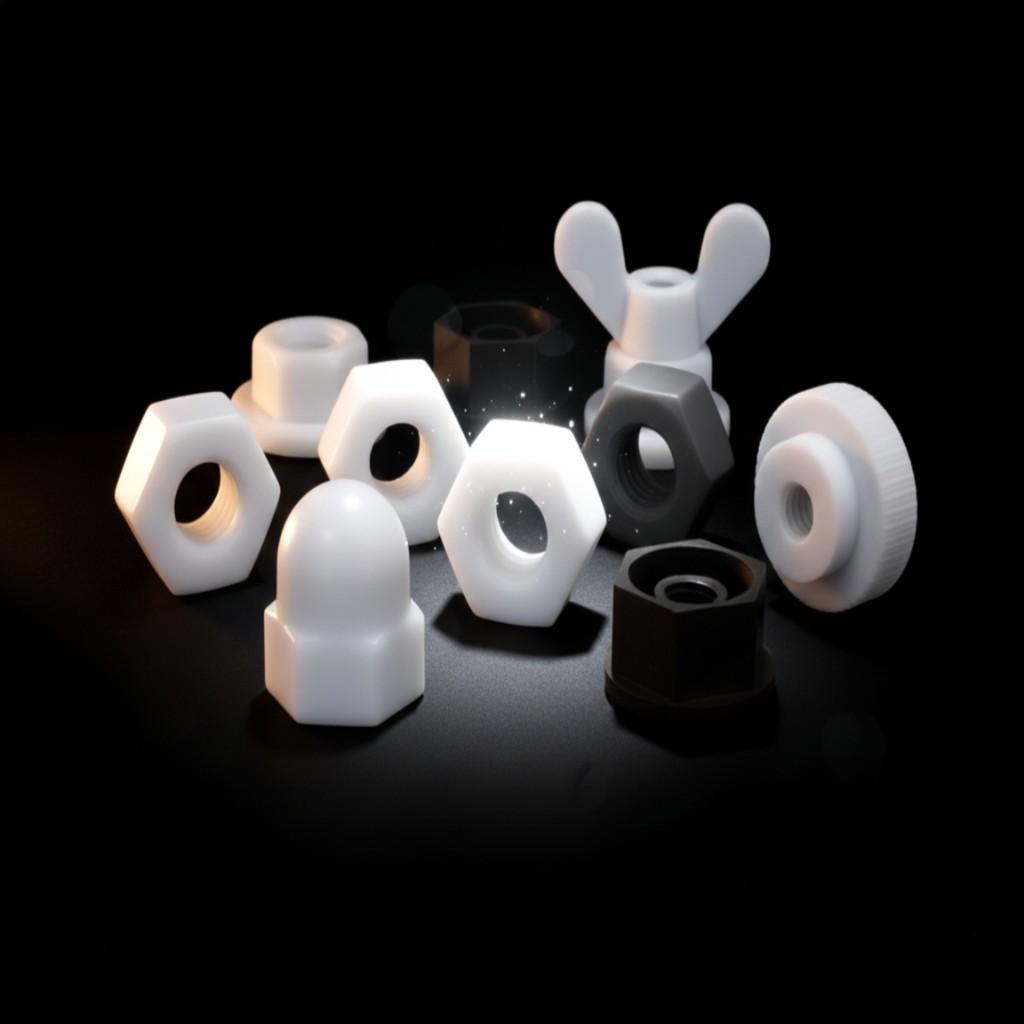
Why Nylon Fasteners Are the Future of Lightweight Construction
Why Nylon Fasteners Are the Future of Lightweight Construction
Nylon fasteners have moved well beyond niche applications. Once confined to electronics and light assembly work, they are now specified by design engineers across food processing, medical devices, automotive interiors, and chemical processing plants. The reason is straightforward: metal fasteners — even stainless steel — are the wrong choice when electrical insulation, weight reduction, or chemical resistance is the primary requirement. This guide explains why nylon fasteners are growing in adoption, how they compare technically to stainless steel, and how to select the right nylon grade and type for your application.
1. Why Nylon Fasteners Are Growing in Industrial Use
The shift toward nylon fasteners reflects broader trends in industrial design: equipment is getting lighter, electronics are getting smaller, and manufacturing environments are becoming more chemically aggressive. Three factors are driving adoption specifically. First, the expansion of electronics manufacturing in India — particularly in Bangalore, Pune, and Chennai — has created demand for fasteners that will not short-circuit PCBs or corrode in humid environments. Second, stricter food safety regulations now require non-metallic fasteners in direct-contact zones, since metal particles from corroded fasteners represent a contamination risk that nylon eliminates. Third, EV manufacturing requires non-conductive fasteners throughout battery and powertrain assemblies to prevent galvanic interference — a requirement that has increased nylon fastener demand sharply since 2020. The result is that what was once a specialty product is now a production staple across multiple industries.
2. Nylon vs Stainless Steel: When to Use Which
The comparison between nylon and stainless steel fasteners is not about which material is stronger — stainless steel wins decisively in most cases. The question is which material is appropriate for the application. Use nylon when: the assembly requires electrical insulation (electronics, battery enclosures, control panels); the environment involves chemicals that attack stainless steel (strong acids, chlorides, bleach solutions); weight is a constraint (aerospace panels, portable instruments, drones); or the fastener must not mark a delicate surface (optical equipment, coated panels, food contact surfaces). Use stainless steel when: structural load-bearing is required; operating temperatures will exceed 120°C (nylon begins to soften and lose clamp load above this); UV exposure is continuous (UV degrades standard PA66 without stabiliser additives); or mechanical impact resistance is essential. A practical rule: if a metal fastener would require a plastic isolation sleeve or insulating washer to prevent electrical contact or galvanic corrosion, fit a nylon fastener directly — it is cleaner, lighter, and often cheaper than the metal-plus-insulation alternative.
3. Technical Properties of PA66 Nylon Fasteners
PA66 (Polyamide 66, also called Nylon 6/6) is the standard material grade for engineered nylon fasteners. Key properties that define where PA66 fasteners perform reliably: Tensile strength: 70–85 MPa — significantly lower than Grade 8.8 steel at 800 MPa, but adequate for non-structural fastening. Compressive strength: 90–100 MPa. Operating temperature: -40°C to +120°C continuous; short-term peaks to +150°C are acceptable. Above 120°C sustained, the material softens and clamp load drops. Density: 1.14 g/cm³ compared to 7.85 g/cm³ for carbon steel — approximately 85% lighter by weight. Water absorption: PA66 absorbs 2.5–3.5% moisture under standard humidity, causing slight dimensional swelling. In precision assemblies with tight clearances, account for this in hole sizing. Chemical resistance: excellent against oils, greases, fuels, and most alkalis; limited against strong mineral acids, oxidising agents, and some solvents. Dielectric strength: 15–18 kV/mm — reliable electrical insulation at voltages used in industrial electronics and control panels. The three most common application errors are exceeding the temperature limit, using nylon in strong-acid environments, and specifying nylon in load-bearing structural joints.
4. Nylon Grades: PA6 vs PA66
Both PA6 (Nylon 6) and PA66 (Nylon 6/6) are used in fastener manufacturing and are visually identical, but their properties differ in ways that matter for demanding applications. PA66 has a higher melting point (262°C vs 220°C for PA6), better stiffness and tensile strength (approximately 10–15% higher than PA6), and lower moisture absorption (2.5–3.5% vs 3.5–5% for PA6). PA6 is slightly tougher and more impact-resistant at low temperatures and easier to mould into complex geometries — making it common in lower-cost fastener production. For engineering applications where dimensional stability under heat and humidity is important — electronics enclosures, automotive under-bonnet components, chemical plant equipment — PA66 is the preferred grade. For general-purpose use such as PCB standoffs, panel spacers, and light assembly fasteners, PA6 is widely acceptable and cost-effective. When sourcing nylon fasteners for a new application, confirm the grade with your supplier. ScrewBazar stocks PA66 nylon fasteners across screws, nuts, washers, and spacers, with grade documentation available on request.
5. Industries Driving Nylon Fastener Adoption
Electronics and semiconductor manufacturing is the largest demand segment for nylon fasteners in India. Every PCB standoff, insulating spacer between a board and a metal chassis, and non-conductive mounting screw in a control panel is typically nylon. Assembly operations in Electronic City Bangalore and Ambattur Industrial Estate Chennai consume nylon M3 and M4 fasteners in very high volumes. Food processing and pharmaceutical manufacturing is the fastest-growing segment. FSSAI and FDA guidelines require non-metallic, non-corrodible fasteners in product-contact zones — nylon screws and nuts are the standard solution for conveyor guides, mixing equipment, and filling line components. Medical device manufacturing uses nylon fasteners extensively in equipment that must be sterilised by autoclaving at 121°C, which is within PA66's continuous-use temperature range. Automotive, particularly EV manufacturing, is emerging as a significant user: battery management systems, wiring harness brackets, and powertrain control modules all require non-conductive fasteners to prevent cross-circuit risks. Chemical and water treatment plants use nylon fasteners for pipework, sensors, and access panels where metallic fasteners corrode despite surface treatment.
6. Types of Nylon Fasteners Available
Nylon screws cover the most common machine screw configurations: pan head Phillips, countersunk (CSK) Phillips, and hex socket (Allen) variants. Pan head nylon screws are the default for PCB mounting and panel assembly. CSK nylon screws provide flush-mount fastening in enclosures and access panels. Nylon hex bolts extend the range to applications requiring wrench tightening. Nylon nuts pair with nylon screws to create fully non-metallic assemblies — essential in electronics where even one metallic nut can create an unintended ground path. Nylon plain washers are the most commonly sourced nylon fastener in electronics manufacturing, used wherever a screw passes through a metal chassis to insulate the connection. They prevent electrical shorts, resist chemicals, and will not mark coated surfaces. Nylon standoffs and spacers create precise gaps between PCBs and enclosures, between stacked circuit boards, and between sensors and mounting surfaces. Available in round plain (through-hole) and hex (wrench-tightenable) profiles, with male-female threaded variants for stackable assemblies. Common sizes run from M2.5 through M6 in lengths from 5mm to 50mm, covering virtually every electronics and light-industrial application.
Browse Nylon Fasteners →
Browse Nylon Fasteners →
7. Sourcing Nylon Fasteners in Bangalore
Bangalore's manufacturing sector — particularly the electronics and EV supply chain in Electronic City, Whitefield, and Peenya — creates steady demand for nylon fasteners in production quantities. The challenge most buyers face is availability of less-common sizes (M2.5, M5, M6 in longer lengths) and material grade confirmation. General hardware distributors typically stock only a narrow range. ScrewBazar supplies PA66 nylon fasteners in screws, nuts, washers, spacers, and standoffs from M2.5 to M10, with same-day dispatch for standard sizes. Bulk pricing is available at 500, 2000, and 10,000+ piece thresholds for production requirements. Material certifications for PA66 grade are available on request — useful for electronics OEMs whose customers require documented material compliance. For sizes or configurations outside the standard range, contact our team with your specification for availability and lead time.
Get Bulk Pricing →
Get Bulk Pricing →
Specify Nylon Fasteners with Confidence
Nylon fasteners are not a compromise — they are the correct engineering choice for a clearly defined set of applications. Understand the operating temperature, the chemical environment, the electrical requirements, and the load profile of your assembly, and the nylon-versus-metal decision becomes straightforward. ScrewBazar stocks PA66 nylon fasteners across all common types and sizes, with same-day dispatch and bulk pricing for production requirements. Contact us to confirm the right grade and configuration for your application.