Socket Head Cap Screws — Complete Guide to Types and Applications
Socket Head Cap Screws — Complete Guide to Types and Applications
Socket head cap screws (SHCS) are among the most versatile and widely used precision fasteners in engineering. Their internal hexagonal socket drive enables high torque application in confined spaces, their cylindrical head provides a clean, mechanical aesthetic, and their availability in high-strength grades makes them the first choice across machinery, automotive, robotics, and precision manufacturing.
1. What Is a Socket Head Cap Screw?
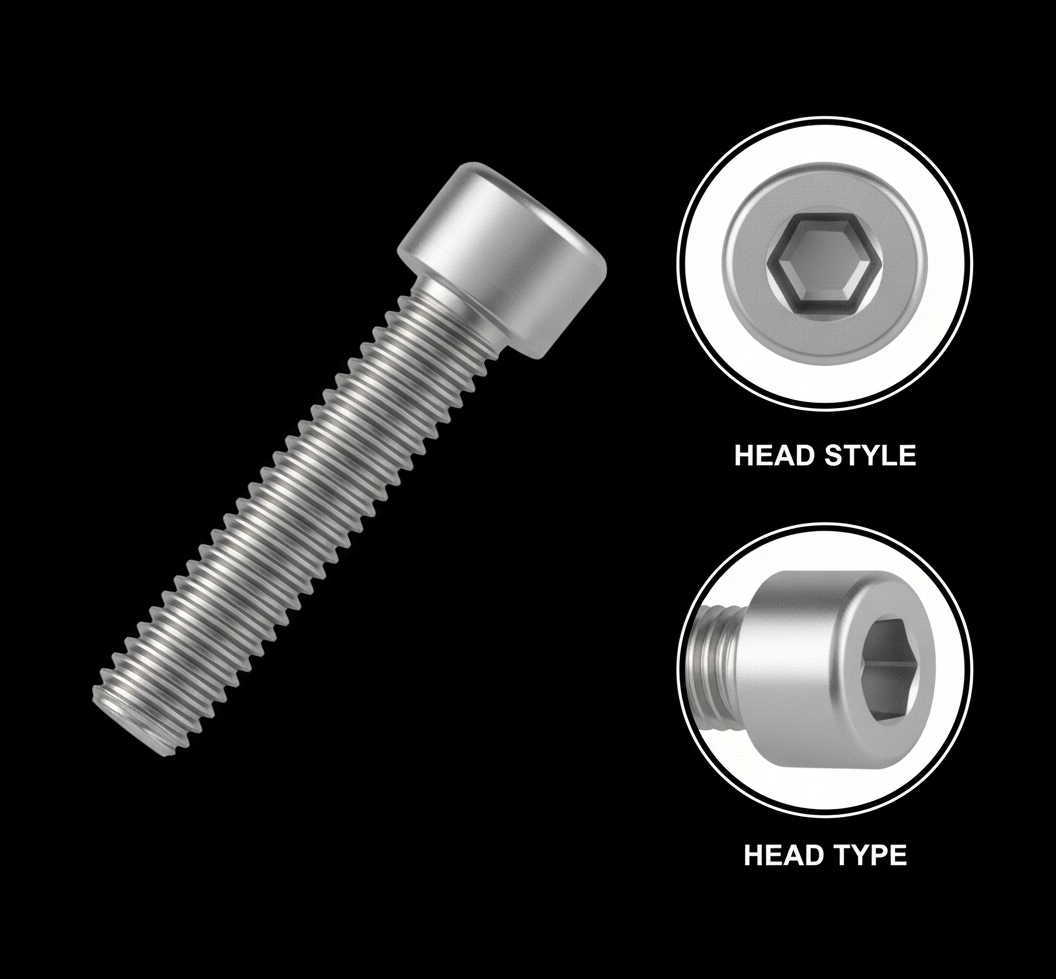
Socket head cap screws — commonly called Allen bolts or SHCS — have a cylindrical head with a deep internal hexagonal socket. The socket is driven using an Allen key (hex key), allowing the tool to access the fastener from directly above without needing clearance around the head. The cylindrical head sits above the workpiece surface. SHCS are the strongest standard head type available — the deep socket allows higher installation torque than button head, pan head, or CSK variants of the same nominal size. ScrewBazar stocks SHCS in sizes from M3 to M24 across stainless steel SS304, Grade 8.8, 10.9, and 12.9.
2. SHCS Grades and Strength
Socket head cap screws are available in a wider range of strength grades than most other screw types. Grade 8.8 (medium strength — 800 MPa tensile, 640 MPa proof) is standard for general machinery. Grade 10.9 (high strength — 1000 MPa tensile) is used in automotive, structural machinery, and high-load applications. Grade 12.9 (ultra-high strength — 1200 MPa tensile) is specified for motorsport, aerospace tooling, and the most demanding industrial connections. Stainless steel SHCS (ISO A2-70, equivalent to Grade 8.8 strength) is used where corrosion resistance is required. Always confirm the grade required before ordering — the difference in clamping force between Grade 8.8 and 12.9 is significant.
3. Socket Head Cap Screw Applications
The applications for socket head cap screws span virtually every industry. CNC machines and machining centres use M6-M12 Grade 12.9 SHCS for fixture plates, clamps, and tooling. Automotive manufacturers specify Grade 10.9 SHCS for engine components, transmission housings, and suspension parts. Robotics and automation equipment use M4-M8 SHCS for frame assembly and end-effector mounting. Medical devices use stainless SHCS for implant-adjacent hardware. Hydraulic systems use high-strength SHCS for manifold and cylinder end cap bolting. The common thread: wherever high clamping force, accessible drive, and controlled assembly are required, socket head cap screws are the answer.
4. Allen Key Sizes and Torque Specifications
Each SHCS size requires a specific Allen key. Using the wrong size — or a worn key — causes socket rounding, screw damage, and lost preload. Standard metric Allen key sizes: M3=2.5mm, M4=3mm, M5=4mm, M6=5mm, M8=6mm, M10=8mm, M12=10mm. Always use quality hex keys — chrome vanadium or S2 steel. Torque specifications for Grade 12.9 SHCS: M4=4.5 Nm, M5=9 Nm, M6=15.5 Nm, M8=38 Nm, M10=76 Nm, M12=132 Nm. Grade 8.8 torque is approximately 70% of Grade 12.9 values. Always use calibrated torque wrenches for critical assemblies — especially in Grade 12.9 where over-torque can cause screw failure.
5. Low Head and Flat Head Variants
Low head socket head screws have the same cylindrical body as standard SHCS but a reduced head height — useful when head clearance is minimal (countersunk pockets, sliding mechanisms). The shallower socket means lower maximum torque, but for many light-load cover plate and access panel applications this is acceptable. Flat head (CSK) socket screws have a countersunk conical head with internal Allen drive — combining flush mounting with socket head torque capability. Button head socket screws have a wide low dome head — providing aesthetics and wide bearing area at the cost of reduced torque capacity. ScrewBazar stocks all these variants — contact our team for sizes and availability.
Browse Socket Head Screws →
Browse Socket Head Screws →
6. Thread Engagement and Joint Design
For socket head cap screws to reach their rated load, thread engagement must be sufficient. Minimum engagement depth: in steel, 1xD (1x nominal diameter); in aluminium, 1.5-2xD; in cast iron, 1.5xD; in plastics and softer materials, 2.5-3xD. Engagement below these minimums results in thread stripping before the screw reaches its rated proof load. Through-bolted assemblies (screw through a hole, nut on the far side) are not limited by engagement depth. For tapped hole assemblies in aluminium (very common in machinery and robotics), use threaded inserts (Helicoil or Keensert) to achieve adequate engagement without excessive boss depth.
7. Selecting the Right SHCS for Your Application
When specifying socket head cap screws, define: material and grade (environment and strength requirement), thread size and length (engagement plus clearance plus head height), and finish (passivated stainless, zinc-plated, or plain for Grade 12.9). ScrewBazar's technical team handles specification queries for OEM buyers, machine builders, and maintenance teams daily. If your application has specific load calculations, operating temperature, or chemical exposure requirements, share these details when enquiring — we will confirm the right specification and provide pricing for the quantities you need.
SHCS in All Grades, In Stock
ScrewBazar stocks socket head cap screws from M3 to M24 in Grade 8.8, 10.9, 12.9, and stainless steel SS304. Whether you need a small quantity for prototyping or a bulk supply for production, contact our team for specifications, pricing, and same-day dispatch.