Complete Guide to Stand-Offs: Blind & Through Hole Types
Complete Guide to Stand-Offs: Blind, Through Hole, Materials & Applications
Stand-offs create precise, reliable spacing between components while providing strong threaded attachment points. Essential in electronics, panels, signage, and architectural applications, stand-offs eliminate the need for separate nuts and spacers by combining spacing and threaded fastening into one component. This guide covers every stand-off type, material, sizing method, and application so you can select the right standoff for your project.
1. Blind Stand-Offs for Sheet Metal and Panels
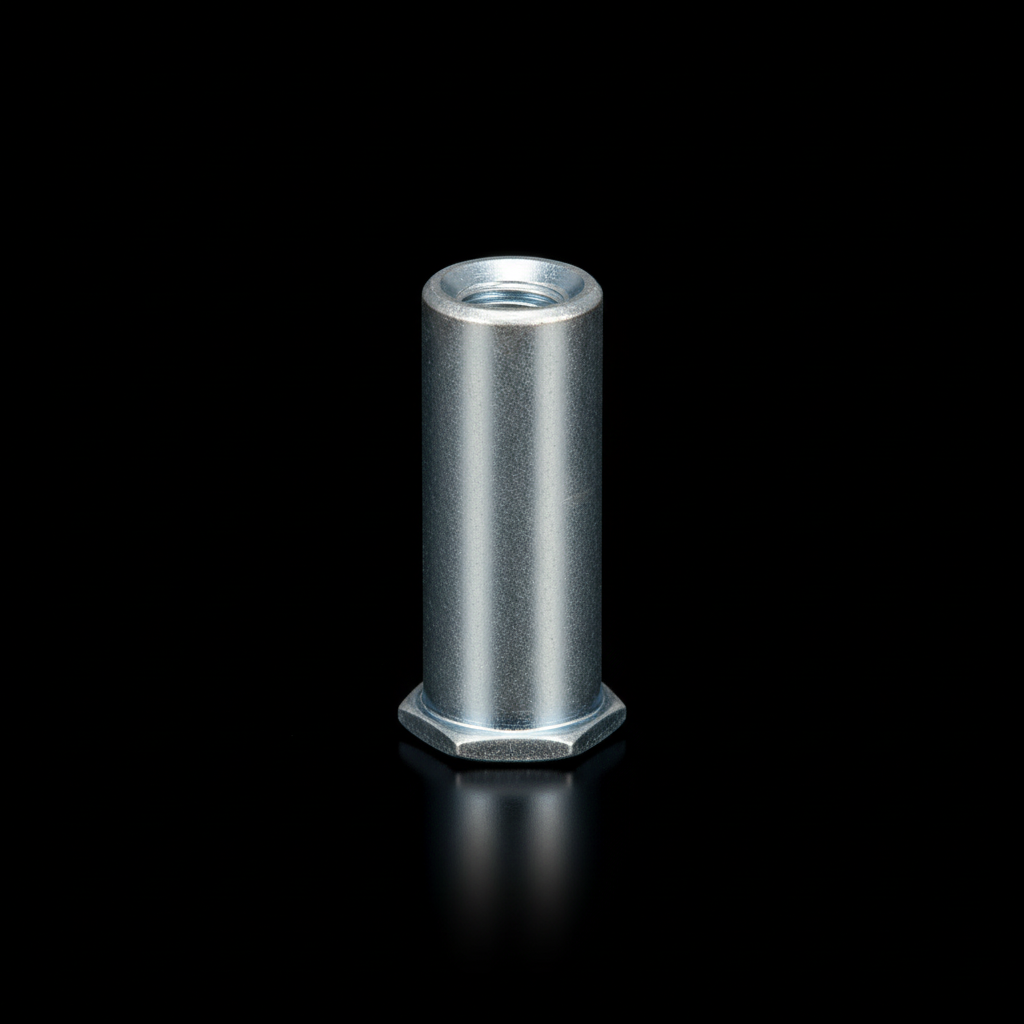
Blind stand-offs (also called blind standoff fasteners or PEM standoffs) are internally threaded fasteners installed permanently into sheet metal, panels, or PCBs where only one side is accessible. Installation requires punching or drilling a hole in the sheet, placing the standoff in the hole, and using a press or installation tool to deform the standoff body. As the standoff is pressed, knurls or ribs on the body bite into the surrounding material while the base flange compresses against the sheet, creating a strong, permanent threaded mounting point without requiring access to the back side. The installed standoff has a smooth external profile on the front side with internal threads ready to accept machine screws from the opposite side. Common thread sizes range from M2.5 to M8. Torque values for the mating screw depend on material and thread size—for M4 in steel, typical installation torque is 1.8–2.2 Nm. Common applications include electronics enclosures (mounting PCBs inside sealed boxes), automotive panels (attaching trim and components to body panels), appliances (mounting controls and covers), and industrial control panels. Available in aluminum (lightweight, non-conductive), steel (high strength), stainless steel (corrosion resistant), and brass (aesthetic applications). Blind standoffs are ideal wherever back-side access is impossible after assembly—making them the standard in sealed enclosures.
Shop Blind Stand-Offs →
Shop Blind Stand-Offs →
2. Through Hole Stand-Offs for Precision Spacing
Through hole stand-offs (also called male-female standoffs or round standoffs) are threaded cylindrical spacers where a mounting screw passes completely through the standoff body. They feature external male threads on one end (screws into the base component), a smooth barrel section (which sets the spacing distance), and a female threaded hole on the opposite end (accepts a mounting screw for the second component). This configuration creates a precise stack-up of components with controlled, repeatable spacing. Unlike blind standoffs—which require permanent press installation—through hole standoffs allow complete disassembly and reassembly using only a screwdriver or Allen key. The length of the barrel determines the gap between components, making accurate length selection critical. Common hex-body designs allow a wrench to tighten the standoff securely into the base. Applications include PCB stacking (creating multi-board assemblies with precise electrical clearance), sign mounting (creating a shadow effect by spacing a sign from a wall), panel mounting (spacing control panels from backing plates), enclosure spacers, and architectural feature mounting. Available in brass (standard electronics grade), aluminum (lightweight), stainless steel (corrosion resistance), and nylon (electrical insulation). Similar in concept to hex spacers, through hole standoffs provide the added benefit of both a female thread for receiving a screw and a male thread for attaching to the base.
Browse Stand-Offs →
Browse Stand-Offs →
3. Stand-Off Materials: Choosing the Right Grade
Selecting the correct material for your stand-off is as important as choosing the correct type. Brass stand-offs are the most common choice in electronics because brass is electrically conductive where grounding is needed, easy to machine to tight tolerances, and naturally corrosion resistant for indoor environments. Brass also has a lower coefficient of thermal expansion than steel, reducing stress on PCBs during temperature cycling. Aluminum stand-offs are preferred in weight-sensitive applications such as aerospace enclosures, camera bodies, and portable instruments—aluminum provides good conductivity at roughly one-third the weight of brass. Stainless steel SS304 stand-offs are used outdoors, in marine environments, food processing equipment, and wherever corrosion resistance is essential without the weight penalty of brass. SS316 is the choice for chemical processing and aggressive salt-spray environments. Steel (zinc-plated) stand-offs offer the highest compressive strength at the lowest cost and are used in industrial panels and heavy-duty brackets where weight is not a concern. Nylon stand-offs provide complete electrical isolation—mandatory when mounting PCBs to metal enclosures that carry mains voltage or high-frequency signals, and used in LED driver mounting, motor driver boards, and RF electronics where metal standoffs would affect signal performance. Nylon also eliminates galvanic corrosion when mating with aluminium enclosures. When selecting material, consider: operating temperature range, electrical conductivity requirements, exposure to moisture or chemicals, mating material (to avoid galvanic corrosion), and load-bearing requirements.
View Stand-Off Range →
View Stand-Off Range →
4. Sizing Stand-Offs: Length, Thread, and Sheet Thickness
Correct sizing of stand-offs requires matching three parameters: thread size, barrel length, and grip range (for blind types). Thread size must match the mating machine screw and the tapped hole in the base component. Common metric sizes are M2, M2.5, M3, M4, M5, and M6—electronics PCBs most commonly use M3 (3mm diameter), while industrial panels use M4 to M6. The thread must be correct pitch (standard or fine) and the screw engaged length should be at least 1.5 times the thread diameter for reliable clamping. Barrel length determines the gap between components. For PCB mounting, calculate the required clearance: minimum clearance = tallest component height + 2mm safety margin. Standard PCB-mounting standoff lengths are 6mm, 8mm, 10mm, 12mm, and 15mm. For sign mounting, the visual standoff gap is typically 10–20mm for a shadow effect, or 25–50mm for a dramatic floating appearance. Sheet thickness (for blind standoffs): each blind standoff has a specified grip range—the range of sheet thicknesses it can grip. For example, a standoff rated 0.8–1.6mm grip range will not install correctly in 2.0mm sheet. Always check the manufacturer grip range specification before ordering. For through hole standoffs, total stack height = standoff barrel length + head heights of mating screws. Common mistakes include: using M3 standoffs with M3.5 screws (thread mismatch), selecting a barrel length that is too short (component interference), and ignoring grip range on blind standoffs (poor installation).
5. PCB Mounting Applications and Best Practices
Stand-offs are the standard method for mounting printed circuit boards (PCBs) inside enclosures, and correct installation is critical for reliability and safety. In PCB assembly, stand-offs serve three purposes: mechanical support (preventing PCB flexing that causes solder joint cracks), electrical grounding (brass or steel standoffs ground the PCB to the enclosure chassis), and thermal management (copper-core standoffs can conduct heat from PCB to the enclosure). For PCB mounting, the recommended process is: (1) identify all PCB mounting hole locations—standard mounting holes are 3.2mm diameter for M3 standoffs; (2) install stand-offs into the enclosure base first using a torque of 0.5–0.8 Nm for M3 brass standoffs in aluminum; (3) lower the PCB onto the standoffs—holes should align without forcing; (4) secure with M3 pan head machine screws at 0.3–0.5 Nm to avoid cracking the PCB substrate. The number of standoffs depends on PCB size: boards under 100×100mm typically use 4 standoffs at corners; larger boards require additional central support to prevent bowing. Use nylon standoffs and nylon washers under screw heads when grounding is NOT desired—for example, when a metal enclosure is at mains potential and the PCB logic runs at 3.3V. Anti-vibration rubber-insert standoffs are available for automotive and industrial applications where vibration would otherwise crack solder joints over time. Always maintain minimum 3mm clearance between the bottom of the PCB and the enclosure base to prevent short circuits from conductive contamination.
Shop PCB Standoffs →
Shop PCB Standoffs →
6. Architectural and Signage Stand-Off Applications
Beyond electronics, stand-offs are widely used in architectural signage, glass mounting, and display systems. Architectural stand-offs (also called cap standoffs or sign standoffs) typically feature a decorative cap that covers the screw head, creating a polished appearance where the fastener itself becomes a design element. Common configurations include: Wall-to-glass mounting—a threaded rod anchors into the wall, a barrel standoff sits against the wall face, and a screw-on cap grips the glass panel from the front, sandwiching the glass between cap and barrel. Glass thickness typically ranges from 6mm to 19mm and the standoff set must match. Panel-to-panel stacking—multiple panels (acrylic, aluminium composite, glass) are stacked at a precise distance using barrel-length standoffs at each corner, creating layered dimensional signage with visual depth. Ceiling-suspended panels—threaded rods connect to ceiling anchors, and standoff barrels create the spacing between horizontally hung sign panels. Stainless steel SS316 is preferred for outdoor architectural applications due to its corrosion resistance and premium appearance. For indoor retail displays, brushed brass or chrome-plated steel standoffs are common. Standoff diameters for signage are typically larger than electronics versions—M6, M8, and M10 are standard for sign mounting—and barrel lengths of 20mm to 100mm create dramatic floating effects. Installation requires pre-drilling the sign material with a hole matching the standoff shaft diameter, not the cap diameter. Always use rubber or neoprene washers between the standoff cap and glass panels to prevent cracking from point loading.
Expert Standoff Selection and Supply
From blind standoffs for permanent sheet metal installation to through hole standoffs for serviceable PCB assemblies, and architectural cap standoffs for signage applications, ScrewBazar supplies the complete range in brass, aluminum, stainless steel, and nylon. Our technical team assists with standoff type selection, thread size matching, barrel length calculation, and material recommendations based on your electrical, environmental, and mechanical requirements. Contact us for technical data sheets, CAD drawings, samples, installation tools, and bulk pricing with same-day dispatch across India. Browse our full standoff range →