Specialized Machine Screws: SEMS, GRUB & JCB Screws Explained
Specialized Machine Screws: SEMS, GRUB & JCB Screws Engineering Guide
Beyond standard machine screws lie specialized fasteners engineered for unique applications: SEMS screws with pre-assembled washers for simplified assembly, GRUB screws for secure shaft locking without protrusion, and JCB screws for extreme-duty construction equipment. This guide provides comprehensive technical insights into these specialized fastener types available at ScrewBazar.
1. SEMS Screws - Pre-Assembled Efficiency
SEMS screws (SEM is abbreviation of "Screw and waSher asSEMblieS") are machine screws with permanently attached washers that cannot be removed. The washer is assembled before thread rolling, capturing it permanently below the head. This pre-assembly eliminates loose washers, ensures washers are always used (preventing assembly errors), reduces part count and inventory complexity, and accelerates assembly line speed. SEMS screws are available in two primary types: Pan SEMS (pan head with various washer types) and Hex SEMS (hex head with integrated flange washer). Washer options include split lock washers (vibration resistance), external tooth washers (anti-rotation), internal tooth washers (confined space locking), and plain washers (load distribution). The captured washer rotates freely on the screw body below the head, allowing normal installation while preventing loss or misplacement. SEMS screws are extensively used in automotive assembly (engine covers, electrical connections), appliance manufacturing (consistent washer use), electronics (ground connections requiring washers), HVAC installation (ductwork assembly), and any high-volume assembly where washer usage is mandatory. Materials include carbon steel zinc-plated (general purpose), stainless steel SS304 (corrosion resistance), and brass (electrical applications). The pre-assembled washer adds minimal cost but provides substantial assembly savings—eliminating separate washer feeding, reducing assembly errors, and ensuring consistent joint quality.
Shop SEMS Screws →
Shop SEMS Screws →
2. Pan SEMS - Versatile Pre-Assembled Fastening
Pan SEMS screws combine low-profile pan head with permanently attached washer, creating versatile fasteners for general assembly applications. The pan head provides good bearing surface and low clearance while the captured washer enhances load distribution, vibration resistance, or anti-rotation depending on washer type selected. Pan SEMS with split lock washers are ideal for vibration-prone applications (automotive, machinery), Pan SEMS with external tooth washers excel in grounding applications (electrical panels, electronics), and Pan SEMS with plain washers suit applications requiring increased bearing area (soft materials, thin substrates). Drive types include Phillips (most common for hand/power tools), hex socket (higher torque applications), and combination drives. Installation is identical to standard pan head screws—the washer automatically positions and compresses during tightening. The free-rotating washer reduces friction during installation, enabling consistent torque-clamp load relationships. Pan SEMS screws are popular in automotive electrical systems (ground connections, sensor mounting), appliance assembly (consistent quality), control panel manufacturing (electrical continuity), machinery assembly (anti-vibration mounts), and electronics (reliable grounding). Materials include zinc-plated steel, stainless steel SS304, and specialized coatings. Sizes M3 to M8 are most common, matching standard machine screw applications. The assembly time savings and error prevention make Pan SEMS cost-effective in high-volume production despite slightly higher unit cost compared to separate screws and washers.
Browse Pan SEMS →
Browse Pan SEMS →
3. Hex SEMS - High-Strength Integrated Flange
Hex SEMS screws feature hexagonal heads with permanently attached flange washers (also called hex flange screws or hex washer head screws). The hex head enables high torque application using wrenches or sockets, while the integral flange washer increases bearing surface and provides vibration resistance. Unlike Pan SEMS which use various captured washer types, Hex SEMS typically have serrated or toothed flanges integrated with the hex head—the serrations bite into both screw head and substrate, preventing rotation under vibration. This design makes Hex SEMS exceptional for automotive applications (engine mounting, suspension components, exhaust systems), machinery assembly (motor mounting, gearbox covers), structural connections (mounting brackets, chassis components), and outdoor equipment (lawn mowers, power tools). The hex head allows much higher installation torque than Phillips or slotted drives—critical for achieving required clamp loads in structural applications. The flange distributes load over area 2-3x larger than hex head alone, preventing pull-through in thin materials and reducing stress concentration. Hex SEMS screws are often used with hex nuts or threaded holes, with the flange on screw side providing anti-vibration locking. Materials include Grade 8.8 and 10.9 carbon steel (high strength), stainless steel SS304 (corrosion resistance), and specialized automotive-grade coatings. Installation torque follows standard hex head specifications: M6=8.4 Nm, M8=20.7 Nm, M10=41 Nm (Grade 8.8). The combination of high-torque hex drive and integrated flange makes Hex SEMS efficient solutions for structural and automotive fastening. Common sizes M6, M8, M10 available at ScrewBazar with full technical specifications.
Shop Hex SEMS →
Shop Hex SEMS →
4. GRUB Screws (Set Screws) - Precision Locking Technology
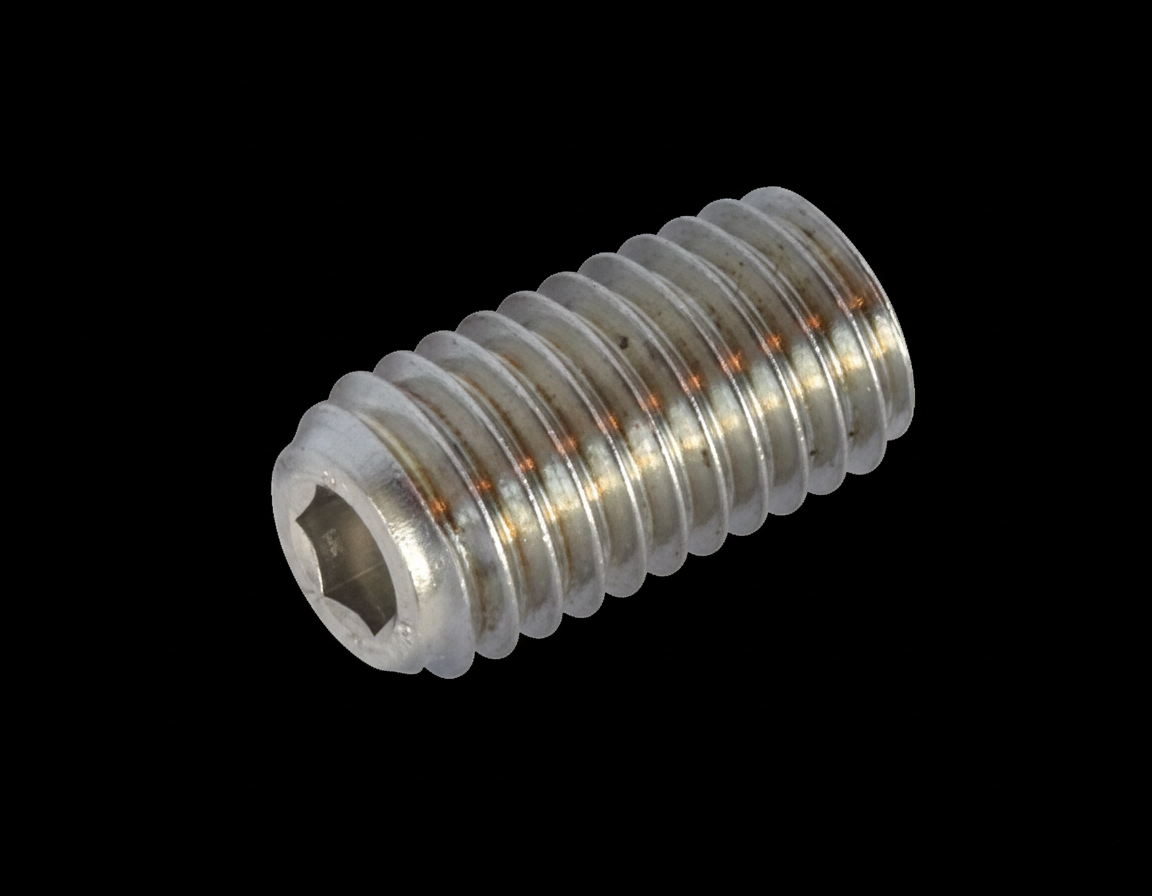
GRUB screws (set screws) are headless fasteners designed to lock components onto shafts, prevent axial or rotational movement, or serve as adjustment stops—all while sitting flush or below the assembly surface. The entire screw length is functional: threaded portion engages tapped hole, and pointed/flat end contacts the secured component. This headless design enables locking without protrusion above the assembly surface—critical in rotating machinery, close-clearance mechanisms, and aesthetic applications. GRUB screw point styles serve specific functions: Cup Point (most common, creates small indentation for secure grip without severely damaging shaft, suitable for temporary or semi-permanent locking), Flat Point (broad bearing surface spreads force preventing shaft damage, ideal where shaft must remain unmarked for future reuse), Cone Point (sharp penetration into soft shafts for maximum holding force, suitable where shaft marking is acceptable), Dog Point (extended cylindrical pilot enters machined groove or hole for precise axial location), Oval Point (minimal shaft marking on hardened surfaces, suitable for hardened shafts where indentation would cause cracking), and Half Dog Point (compromise between dog point location and cup point grip). Materials include hardened alloy steel Grade 14.9 (45H carbon content, hardened to 52-58 HRC for maximum holding force), stainless steel SS304 (corrosion resistance in marine/food applications), and brass (non-sparking in explosive environments, non-magnetic for scientific instruments). Installation requires correct torque: over-tightening shears screw or damages threads, under-tightening allows slippage. Apply thread locker (Loctite 243 medium strength for serviceable connections, Loctite 271 high strength for permanent) to prevent vibration loosening. Common sizes M3 to M12 with lengths from 3mm to 50mm.
Shop GRUB Screws →
Shop GRUB Screws →
5. GRUB Screw Applications and Installation Best Practices
GRUB screws (set screws) are essential across diverse applications: Collar and Pulley Mounting (securing pulleys, gears, couplings, sprockets, and bushings onto rotating shafts—cup point is standard, flat point where shaft reuse is required), Gear and Bearing Positioning (preventing axial migration on shafts—dog point locates in shaft groove for precise positioning), Door Hardware (adjustment stops in hinges, latches, and closers—cone point provides secure locking), Precision Instruments (non-magnetic brass GRUB screws for laboratory and medical equipment—flat point prevents magnetic distortion), Electrical Equipment (terminal locking, busbar positioning—stainless steel for corrosion resistance), and Machinery Alignment (adjustable stops and position locks). Installation best practices: 1) Drill and tap hole perpendicular to shaft, 2) Deburr hole to prevent thread damage, 3) Clean threads of cutting oil/debris, 4) Apply appropriate thread locker, 5) Drive GRUB screw to specified torque using hex key (cup point) or screwdriver (slotted types), 6) For maximum holding force, position GRUB screw over keyway or flat on shaft, 7) In critical applications use two GRUB screws 90° or 180° apart, 8) In high-vibration environments, stake GRUB screw with center punch after installation. Torque specifications (Grade 14.9, cup point, dry threads): M3=1.5 Nm, M4=3.5 Nm, M5=6.5 Nm, M6=11 Nm, M8=27 Nm. Inspection: check for shaft marking depth (should be 0.1-0.3mm for cup point), verify no rotation under load, monitor for loosening after initial operation period. ScrewBazar supplies GRUB screws with detailed point style selection guide and installation specifications.
6. JCB Screws - Heavy Construction Equipment Grade
JCB screws are specialized high-strength fasteners designed for construction equipment, earthmoving machinery, and heavy industrial vehicles. Named after JCB (J.C. Bamford Excavators Ltd., leading construction equipment manufacturer), these screws withstand extreme loads, shock, vibration, and harsh environmental conditions. JCB screws typically feature deep hex sockets for positive tool engagement (even when filled with mud/debris), high-strength materials (Grade 10.9 or 12.9 alloy steel providing 1000-1200 MPa tensile strength), specialized coatings (zinc-flake, geomet, dacromet for salt/moisture resistance), and often include thread-locking features (prevailing torque nuts, thread patches, mechanical deformation). Applications span excavator structures (boom, stick, bucket mounting requiring shock resistance), loader equipment (bucket pivot points, lift arm connections), bulldozer components (blade mounting, track components), crane assemblies (boom sections, outrigger connections), mining equipment (heavy-duty structural connections), and agricultural machinery (implement attachment points). Material specifications are stringent: high-grade alloy steel (40CrMo, 42CrMo) provides both strength and toughness, heat treatment (quench and temper) achieves required mechanical properties, and protective coatings prevent corrosion without compromising fatigue life. Installation follows strict procedures: threads must be clean and dry, correct torque sequence prevents distortion, calibrated torque wrenches ensure specified preload, and periodic retorquing may be required after initial operation (bedding-in period). Certification and traceability are essential—each batch should include material certificates, heat treatment records, and dimensional inspection reports. JCB screws often come with part numbers cross-referencing OEM specifications. At ScrewBazar, we supply genuine-grade JCB screws meeting or exceeding OEM standards with full documentation for fleet maintenance and equipment repair.
Specialized Fastening Expertise
From assembly-efficient SEMS screws to precision-locking GRUB screws and heavy-duty JCB screws, ScrewBazar provides specialized machine screw solutions for unique applications. Our technical team offers point style selection for GRUB screws, washer type recommendations for SEMS, and OEM cross-reference for JCB screws. Contact us for engineering support, application guidance, bulk pricing, and same-day dispatch.