Grub Screw (Allen Grub Screw)
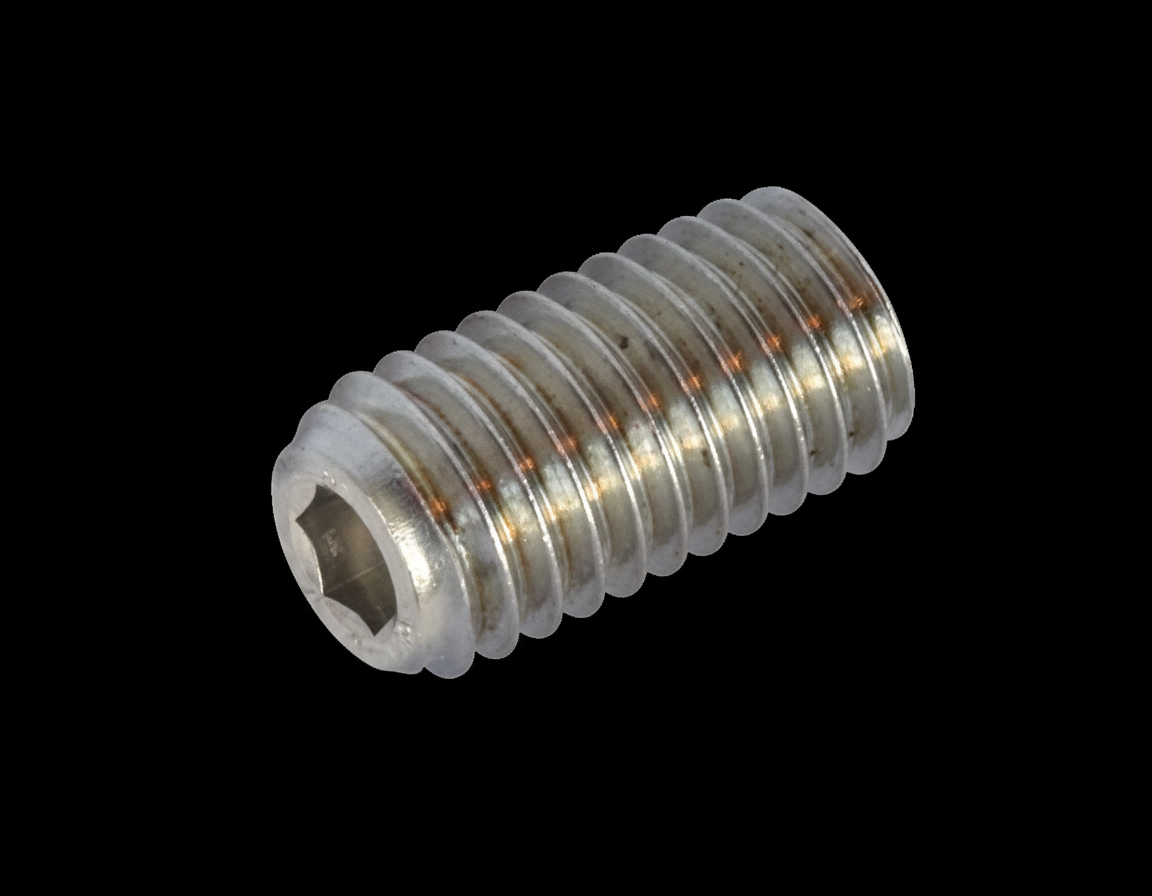
Stainless Steel 202
DIN 913 / ISO 4026| mm | 3 | 4 | 5 | 6 | 8 | 10 | 12 | 16 | 20 | 25 | 30 | 35 | 40 | 45 | 50 | 55 | 60 |
|---|---|---|---|---|---|---|---|---|---|---|---|---|---|---|---|---|---|
| M3 | — | — | — | — | — | — | — | — | — | ||||||||
| M4 | — | — | — | — | — | — | — | — | — | ||||||||
| M5 | — | — | — | — | — | — | — | — | — | ||||||||
| M6 | — | — | — | — | — | — | — | — | — | ||||||||
| M8 | — | — | — | — | — | — | — | — | |||||||||
| M10 | — | — | — | — | — | — | — | ||||||||||
| M12 | — | — | — | — | — | — | |||||||||||
| M16 | — | — | — | — | — | — | — | ||||||||||
| M20 | — | — | — | — | — | — | — | — |
Selected: Stainless Steel 202 · choose a size from the chart
Available in Stainless Steel 202, Stainless Steel 304 / A2-70, Stainless Steel 316 / A4-70, Mild Steel, Brass and Black Oxide. Standard sizes (DIN 913 / ISO 4026): M3 (3-16mm), M4 (4-20mm), M5 (5-25mm), M6 (6-30mm), M8 (8-40mm), M10 (10-50mm), M12 (12-60mm), M16 (16-60mm), M20 (20-60mm). Request a quote for your exact requirement.
An Allen Grub Screw is a headless screw with an internal hex drive designed to sit entirely within a threaded hole, providing a clean and concealed fastening solution. It is primarily used to lock components onto a shaft or prevent movement between parts, offering strong holding force in tight or compact mechanical assemblies. Also commonly known as Allen Grub Screw or Socket Set Screw in the trade.
About Grub Screw
Grub screws are headless, fully threaded screws with a hex socket drive at one end. They are also called socket set screws or Allen grub screws. A grub screw is tightened through a threaded hole until its point presses on a shaft, which stops a pulley, collar, gear or knob from turning or sliding. Because there is no head, the screw sits flush with or below the surface. The point type sets how it grips. DIN 913 (ISO 4026) has a flat point, DIN 914 (ISO 4027) a cone point, DIN 915 (ISO 4028) a dog point and DIN 916 (ISO 4029) a cup point. Steel grub screws are made in property class 45H, which means a minimum hardness of 450 HV. Stainless grub screws are made in A2 and A4.
Applications
- •Locking pulleys and gears onto shafts
- •Shaft collars and couplings
- •Knobs, handles and dials
- •Bearing and bushing retention
- •Adjustment and stop screws in fixtures
- •Locating components through a threaded hole
Specifications
- Materials
- SS 202, SS 304 (A2), SS 316 (A4), Mild Steel, Alloy Steel Black Oxide (45H), Brass
- Size range
- M3 to M16 metric coarse thread, lengths 3 mm to 40 mm
- Standards
- DIN 913 / ISO 4026, DIN 914 / ISO 4027, DIN 915 / ISO 4028, DIN 916 / ISO 4029
Industries served
- Power transmission
- Industrial machinery
- Automotive
- Packaging machinery
- Instrumentation
Related categories
Grub Screw: frequently asked questions
Which grub screw point type should I use?
Use a cup point (DIN 916) for general shaft locking, because it bites into the shaft and resists vibration. Use a flat point (DIN 913) on hardened shafts or where the shaft must not be marked. Use a cone point (DIN 914) for permanent location in a drilled spot, and a dog point (DIN 915) to engage a groove or hole.
What does 45H mean on a grub screw?
45H is the property class for hardened steel set screws under ISO 898-5. It means a minimum Vickers hardness of 450 HV. Grub screws are classed by hardness instead of tensile strength because they work in compression against a shaft.
What Allen key size fits a grub screw?
Grub screws use M3 = 1.5 mm, M4 = 2 mm, M5 = 2.5 mm, M6 = 3 mm, M8 = 4 mm, M10 = 5 mm and M12 = 6 mm hex keys. The socket is small, so use a good-quality key and seat it fully before tightening.
What size grub screw should I use for a shaft?
A common rule is to use a grub screw diameter of about half the shaft diameter, for example an M6 grub screw on a 12 mm shaft. Grinding a small flat on the shaft for the point to sit on increases holding power and makes removal easier.
Is a grub screw the same as a set screw?
Yes. Grub screw is the common term in India and the UK, and set screw is the common term in the US. Both describe a headless screw tightened against another part. In some UK catalogues "set screw" also means a fully threaded hex bolt, so confirm the standard when ordering.