Hex Nut (Hexagon Nut)
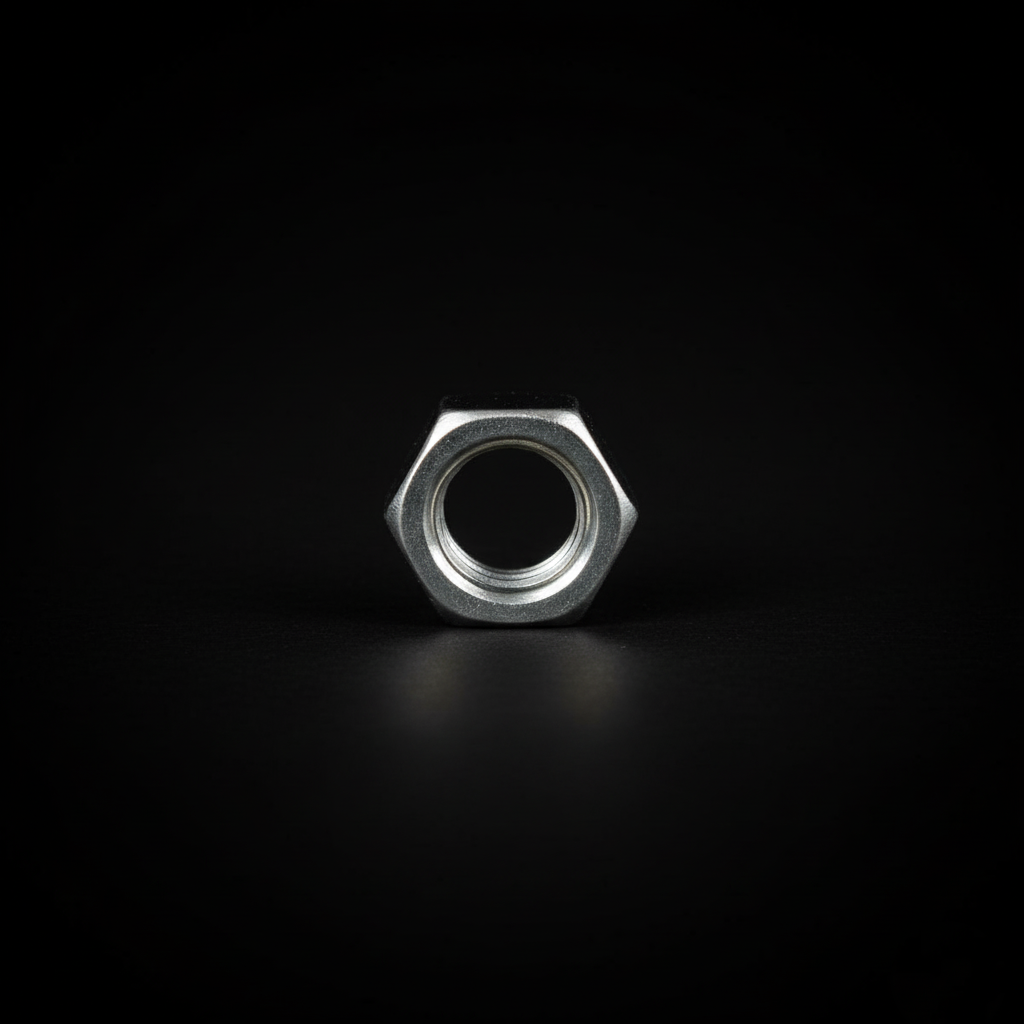
Stainless Steel 304 / A2-70
DIN 934 / ISO 4032| Size | M2 | M2.5 | M3 | M4 | M5 | M6 | M8 | M10 | M12 | M14 | M16 | M18 | M20 | M22 | M24 | M27 | M30 | M36 |
|---|---|---|---|---|---|---|---|---|---|---|---|---|---|---|---|---|---|---|
| DIN 934 |
Selected: Stainless Steel 304 / A2-70 · choose a size from the chart
Available in Stainless Steel 304 / A2-70, Stainless Steel 316 / A4-70, Mild Steel, Galvanized Steel and Brass. Standard sizes (DIN 934 / ISO 4032): M2, M2.5, M3, M4, M5, M6, M8, M10, M12, M14, M16, M18, M20, M22, M24, M27, M30, M36. Request a quote for your exact requirement.
A Hex Nut is a six-sided fastening component designed to mate with bolts, screws, and threaded rods to secure parts together. Its hexagonal shape allows easy tightening from multiple angles using wrenches or sockets, providing strong load distribution and reliable fastening. Known for versatility and durability, hex nuts are widely used across mechanical, structural, and industrial applications. Also commonly known as Hexagon Nut or Standard Nut in the trade.
About Hex Nut
Hex nuts are six-sided, internally threaded fasteners that are tightened onto a bolt, stud or threaded rod. They are also called hexagon nuts or full nuts. The common standards are DIN 934, ISO 4032 and IS 1364 Part 3. A DIN 934 nut is about 0.8 times the thread diameter in height. An ISO 4032 nut is slightly taller and, in M10, M12, M14 and M22, has a smaller width across flats. Steel nuts are graded by property class. A class 8 nut matches a class 8.8 bolt and a class 10 nut matches a class 10.9 bolt. Stainless steel nuts are A2-70 (SS 304) and A4-70 (SS 316). Thin lock or jam nuts are made to DIN 439 and ISO 4035.
Applications
- •Bolted joints in machinery and equipment
- •Structural steel and fabrication
- •Threaded rod and anchor assemblies
- •Automotive and two-wheeler assembly
- •Electrical panels and earthing (brass nuts)
- •Pipe supports and hangers
Specifications
- Materials
- SS 304 (A2-70), SS 316 (A4-70), Mild Steel, High Tensile Steel (Class 8 / 10), Galvanised Steel, Brass
- Size range
- M3 to M30 metric coarse thread; fine pitch on request
- Standards
- DIN 934, ISO 4032, IS 1364-3, DIN 439 / ISO 4035 (thin)
Industries served
- Construction
- Automotive
- Industrial machinery
- Electrical
- Fabrication
Related categories
Hex Nut: frequently asked questions
Which nut grade should I use with a grade 8.8 bolt?
Use a property class 8 nut, or higher, with a class 8.8 bolt. Use a class 10 nut with a class 10.9 bolt. A lower-grade nut can strip its thread before the bolt reaches full preload.
What is the difference between DIN 934 and ISO 4032 nuts?
ISO 4032 nuts are slightly taller than DIN 934 nuts, for example 8.4 mm against 8 mm in M10. In M10, M12, M14 and M22 the ISO nut also has a smaller width across flats: 16 mm instead of 17 mm in M10, and 18 mm instead of 19 mm in M12. Both fit the same bolt thread.
Why do stainless steel nuts seize on stainless bolts?
SS 304 and SS 316 threads can gall, meaning the surfaces cold-weld under pressure and friction. To prevent this, tighten slowly, avoid power tools at high speed and apply an anti-seize compound. Mixing A2 and A4 grades does not prevent galling.
What is a jam nut?
A jam nut is a thin hex nut, made to DIN 439 or ISO 4035, that is about half the height of a standard nut. It is tightened against a full nut to lock it in position. It is not designed to carry the full load of the bolt on its own.
When should I use brass hex nuts?
Use brass nuts on electrical terminals, earthing studs and panels, because brass conducts well and does not rust. Brass is also non-magnetic and does not spark. It is much weaker than steel, so do not use brass nuts for structural loads.